Instructions on Making Prostrations (Dudjom Tersar Ngöndro)
by Chagdud Tulku
Visualize Guru Rinpoche in the space in front of you, luminous, exuding youthful vitality. He has a white complexion tinged with a red radiance. His expression — a slight smile, the furl of his brow, wide-open eyes — conveys compassion, but with a sense of alertness, the union of all peaceful and wrathful qualities.
He sits in vajra posture on a thousand-petaled, multicolored lotus upon which rest a sun disk and a moon disk — the lotus a symbol of the innate purity of samsara and nirvana; the sun disk, enlightened compassion; the moon disk, pristine awareness. His right hand holds a five-pronged vajra to his heart; his left holds a skullcup filled with elixir of deathless realization, a long-life vase floating atop it.
In the crook of his left elbow rests a khatvanga (trident), its three prongs symbolizing emptiness, clarity, and compassion, the inseparable nature of the three kayas. The shaft of the trident is ornamented at the top with a skull, then a decayed head and a freshly severed head, representing atemporal realization of the three kayas.
Below the heads are a longevity vase, a pair of crossed vajras that symbolize mastery of the four activities (subduing, increasing, magnetizing, wrathful intervention), and a skull drum from which waft silk scarfs. The khatvanga indicates the fruition of the third, or wisdom (transcendent knowledge and pristine awareness), empowerment (discussed later in the chapter on guru yoga), and its secret symbolism expresses Guru Rinpoche's inseparable union with his wisdom consorts, Mandarava and Yeshe Tsogyal.
Guru Rinpoche's robes include a white inner garment, which represents the pure, unstained vajra; the blue long-sleeved robe of a Vajrayana practitioner; red monastic robes; and the outer brocade cloak of a sovereign. He is adorned with a resplendent breastplate and earrings, and wears the lotus hat that liberates on sight, which is emblazoned with a sun and moon expressing skillful means and pristine awareness.
Its brim forms three points, symbolizing the three kayas, and has five colors, symbolizing the five kayas—dharmakaya, sambhogakaya, nirmanakaya, svabhavikakaya, and the unchanging vajrakaya. The hat's peak is ornamented by a half vajra, symbol of unwavering concentration, and, extending from this half vajra, a vulture feather, symbolizing the highest view.
Visualize your father standing on your right side, your mother on your left, enemies prostrating in front of you, and demons behind you. The ranks of all sentient beings surround you and simultaneously prostrate, their recitation reverberating like the buzzing of bees.
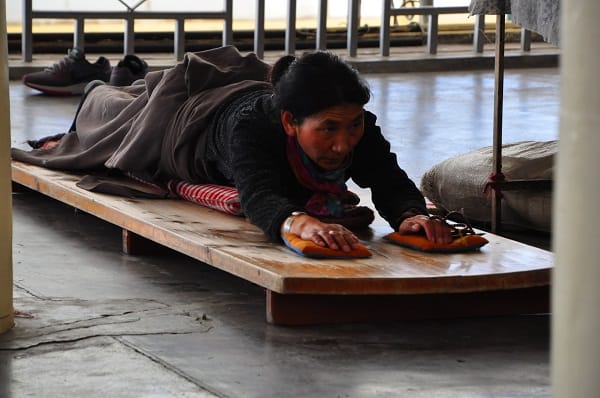
To perform a prostration, stand up straight with feet together. Bring your hands together in the “lotus bud” mudra (the base of the palm and the fingertips together, and thumbs slightly tucked in) and place them on the crown of the head, then to the throat and heart. As you place your hands on your crown, you offer homage to Guru Rinpoche's enlightened body, purify defilements and obscurations incurred through the avenue of your body, and establish the potential to realize nirmanakaya.
At your throat, you offer homage to his enlightened speech, purify defilements and obscurations incurred through your speech, and establish the potential to realize sambhogakaya. Bringing your hands to your heart, you offer homage to his enlightened mind, purify your mind's obscurations, and establish the potential to realize dharmakaya.
The actual prostration is performed by dropping the body forward and stretching it full length on the floor, the arms outstretched in front. As you touch the floor, the five poisons — ignorance, attachment, anger, pride, and jealousy — dissipate. Again, with hands in the lotus bud mudra, bend your arms back and touch your hands to the top of your head, a gesture that acknowledges the blessing flowing from Guru Rinpoche. Then stretch your arms out once more and push yourself up. As you stand, the clearing away of the five poisons allows the five wisdoms to arise. Bring your hands into the lotus bud mudra for the third time and touch your heart in a gesture of reverence. Then, with a smooth motion, bring your hands to your crown and perform the next prostration.
Hold a mala in your left hand to count. A full-sized mala of one hundred and eight or one hundred and eleven beads may be used. However, it is easier to count with a prostration mala made up of twenty-seven large-diameter beads (large-diameter beads so the hand does not cramp), moving a stone each time the mala is circled and moving a hundred marker on your counters when you have completed four malas, that is, one hundred and eight prostrations. It is important to count with a mala rather than mentally keep track so that the mind remains fully engaged in the visualization, in refuge, bodhicitta, and devotion to Guru Rinpoche.
After finishing the number of prostrations scheduled for the session, move into the completion stage, visualizing that all beings dissolve into light, which dissolves into Guru Rinpoche, then into you. Rest there, in uncontrived, non-conceptual meditation. When thoughts intervene, dedicate the merit of your prostrations according to the dedication prayer in the ngondro practice, adding any others you choose.
If you are continuing the ngondro session through mandala offerings, the completion stage dissolution is performed after the mandalas.
Having finished prostrations, maintain the visualization of Guru Rinpoche in the space in front of you and simply sit down to begin mandalas.
Whether after prostrations or after mandalas, leave time to close the meditation properly. You will deny yourself profound opportunities for realization if, upon completion of prostrations, you simply walk away from the mat without dissolution and dedication.
Chagdud Tulku, Ngondro Commentary